Yes, renaming RM shows commitment to diversity
With the approaching arrival of this year’s Independence Day on July 4, America will officially be 250 years old. As many students have learned at some point during their American history classes, our nation’s history is both a story of freedom and captivity. It is a story of liberation and revolution for the founding fathers, but it is also a long-hidden history of enslaved people who, in many ways, were the true builders of our democracy.
However, despite the now-increased awareness of the atrocities committed against enslaved people in the infancy and childhood of America’s ongoing lifetime, major figures who took part in this violence continue to be glorified through statues and structures dedicated to them or named after them, with our very own high school and school county being one such namesake. The names of our school and county must be changed in order to show respect for the diverse student community which the name of an enslaver not only misrepresents, but also shows exclusion towards.
According to The Army Historical Foundation, General Richard Montgomery was originally a member of the British Royal Army, fighting in the French and Indian War on behalf of England. However, he later moved to the colonies, and as colonial tensions rose, he sided with the revolutionary movement against the British Crown. Appointed a brigadier general in the Continental Army on June 22, 1775, Montgomery is credited with capturing Fort Chambly, St. John’s and Montreal before the first revolutionary general killed in battle against British forces while advancing on Quebec. Famously, he chose to go to battle despite hesitancy and desire to stay with his wife and farmland, saying that “the will of an oppressed people… must be respected” according to Montgomery Lodge No. 13.
However, this quote, often cited as an example of General Montgomery’s valiance and nobility in his role as a member of the American revolutionary forces, becomes almost unbelievably ironic when considered against the backdrop of Montgomery’s status as a slaveowner. According to Montgomery History, students from Watkins Mill High School were the first to find evidence of this in 2018, after they discovered mentions of enslaved people as assets in Montgomery’s will to be passed on to his wife. The discovery would then go on to spark a renaming debate surrounding not only Richard Montgomery High School, but also Montgomery County as a whole, which is also named after General Mogntomery.
Having our schools and county named after a man who owned slaves, no matter his other achievements or how widespread knowledge of his enslaving status was, is absolutely unacceptable. “I mean, this guy had slaves. That’s an obvious moral issue with him being what our school’s named after,” senior Sarah Minicozzi said.
The MCPS Board of Education’s Naming School Facilities Policy states that names of school facilities in MCPS must contribute to their overall mission of “Nondiscrimination, Equity, and Cultural Proficiency.” It also states that “naming a school facility… is a high honor that should be reserved for ideals, core values, and… equitably represent the diversity of Montgomery County.” No one can argue that a man, General Richard Montgomery, who enslaved people and saw other human beings as inferior and subservient to him is emblematic of the “diversity of Montgomery County” or should remotely be deserving of the honor that comes with having a building named after him.
Our school and county are extremely diverse, and this is an asset to all of the students and members of our county community. “Diversity is an important aspect of community because I guess we can learn from people who are different from you in a lot of ways. And I think that’s an important thing when you have people learning in one of the most formative times of their life,” Minicozzi said. Naming a school after a man who enslaved people is not conducive to a diverse environment and reveals a level of prioritization taking place, where the suffering that African American slaves underwent as a result of slavery is ignored in favor of other historical achievements.
While it is true that General Richard Montgomery was an influential historical figure, that does not necessarily mean that we should glorify him in the way that naming buildings after him would. “I know a lot of the founding fathers had slaves, and we should not glorify them. We should acknowledge that they had slaves,” senior Grace Cao said. It is incredibly important that we remember the full history of our country. Glorifying revolutionary figures through monuments and school buildings commemorates only their historical achievements, while distracting from and deemphasizing the extent of the suffering that they inflicted as participants in the slave trade.
The intent to commemorate parts of our revolutionary past and inspire a sense of independence and liberty by naming our school after General Montgomery does not overrule the outcome, where we find ourselves tied to the legacy of an enslaver, complicit in the suffering of hundreds of people.
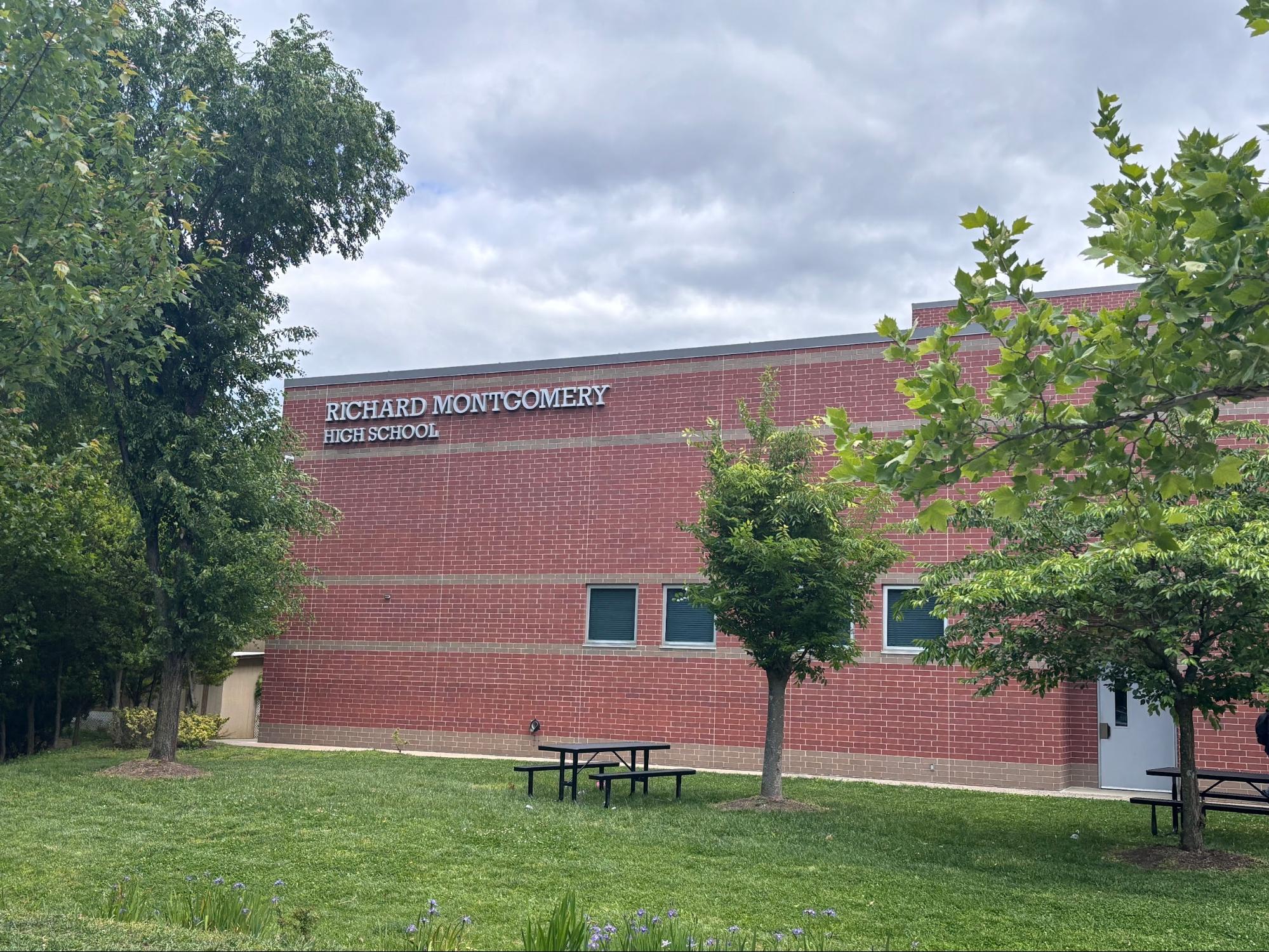
We want to create an environment that is accepting and welcoming so that everyone who comes here is able to feel like they belong in the place where they are learning. According to the Richard Montgomery High School website, one of RM’s beliefs is “in fostering a diverse, inclusive community to develop open-minded, caring, reflective students.” Creating a place where people feel safe and are able to learn starts with the name that people see when they walk into the front doors of the main entrance. It starts when they pass by the name on the sign at the beginning of the school parking lot. Changing RM’s name is crucial to fulfilling our commitment to a diverse community, and failing to do so demonstrates a failure to meet the needs of students.
No, renaming RM is unpractical, costly
The arrival of America’s 250-year anniversary this July encourages staff and students to reflect on the legacy of the nation—and more specifically, the individuals and stories behind those individuals that make up the legacy. One of those individuals is Richard Montgomery.
Richard Montgomery brings a complicated legacy. A Revolutionary War general for the Continental Army, he is widely regarded as the war’s first famous martyr. Killed during his assault on British-owned Quebec, he remains honored as a hero through not only the school’s name, “Richard Montgomery” but the county’s name “Montgomery County.” However, a lesser-known fact is Richard Montgomery’s ownership of slaves, which was revealed through examination of his will where he bequeathed his ownership to his wife.
Recent removals of numerous Confederate monuments and implications of white supremacy and pro-slavery sentiments leave many concerned that the school’s naming contradicts its mission of diversity and inclusivity. This is particularly significant to RM because of its status as one of the most diverse schools in Montgomery County. “I think it’s already known for being diverse, but especially in RM, I’m pretty sure we’re a majority minority school…I really do think that having a diverse range of voices at RM is really beneficial to the learning environment,” senior Grace Cao said. “Especially because it’s really easy these days to really get swept up into your own little bubble, but really interacting with people who are just different from you, can really help humanize them, even like in a time where, you know, a lot of people are demonized online.”
Nevertheless, renaming the school also raises numerous problems.
For one, Richard Montgomery has functioned as the school’s name brand for nearly a century—renamed from Rockville High School in 1935. Today, the long-standing name is significant both to the RM school community and neighboring schools. “Richard Montgomery was not the best person, but I don’t really care about a name change,” sophomore Alaina Lee said. “I want to be here for another 2 years. And Richard Montgomery…everybody knows that name. So I feel like if we change it, people are like, ‘What’s that school?’”
While Richard Montgomery’s legacy of slave-ownership exists at odds with the school’s mission of inclusivity, the legacy of the man also does not translate to the school’s legacy. “I don’t really think anyone would go and look on Google, like, ‘Who is Richard Montgomery?’ Oh, he owns slaves,” said senior Serena Lendja. “I don’t think that really matters because it was like a long time ago. But it’s not what we are promoting. Obviously, don’t promote that.” RM is known as one of the county’s most diverse schools, taking pride in its 72% minority enrollment and representation and continues to redefine the legacy behind the name. “You get to meet a lot of different people from a lot of different cultures and learn about what people’s lives are like from people from different cultures,” Lee said. “As someone from a minority group, it’s easy to find a community of people who are from East Asia like I am.
George Washington is another example of a traditionally historical “hero” (and founding father) who owned slaves. During the Industrial Revolution, Cornelius Vanderbilt was an infamous robber baron, who employed predatory business practices and exploited cheap laborers in terrible working conditions. Yet, elite colleges like George Washington University and Vanderbilt University continue to capitalize on their name brands to attract thousands of students and applicants every year. Meanwhile, RM is known for its International Baccalaureate program. Should we capitalize the same way?
The financial burden of renaming RM is significant as well. A name change would mean a wave of costs associated with jersey changes, equipment rebrandings and other aesthetic charges. These same funds could instead be redirected to improving necessary building facilities, educational programs and creating impactful opportunities for RM students.
At the same time, the possibility of RM’s renaming raises debates on the significance of “hero” figures like Richard Montgomery and the way we ought to evaluate their legacies within the historical context. Richard Montgomery remains a controversial figure but it also seems important to dissect and acknowledge the controversy of his legacy rather than erase his name entirely. “It’s really important to not glorify people who were harmful in the past, especially with slavery,” Cao said. “I know a lot of the founding fathers had slaves, and we should not glorify them, and we should acknowledge that they had slaves.”
If you would like to voice your opinion on an issue you feel is relevant to our community, please do so here. Anyone is able and welcome to submit a Letter to the Editor, regardless of journalistic experience or writing skills. Submissions may be published either online or in a print issue.