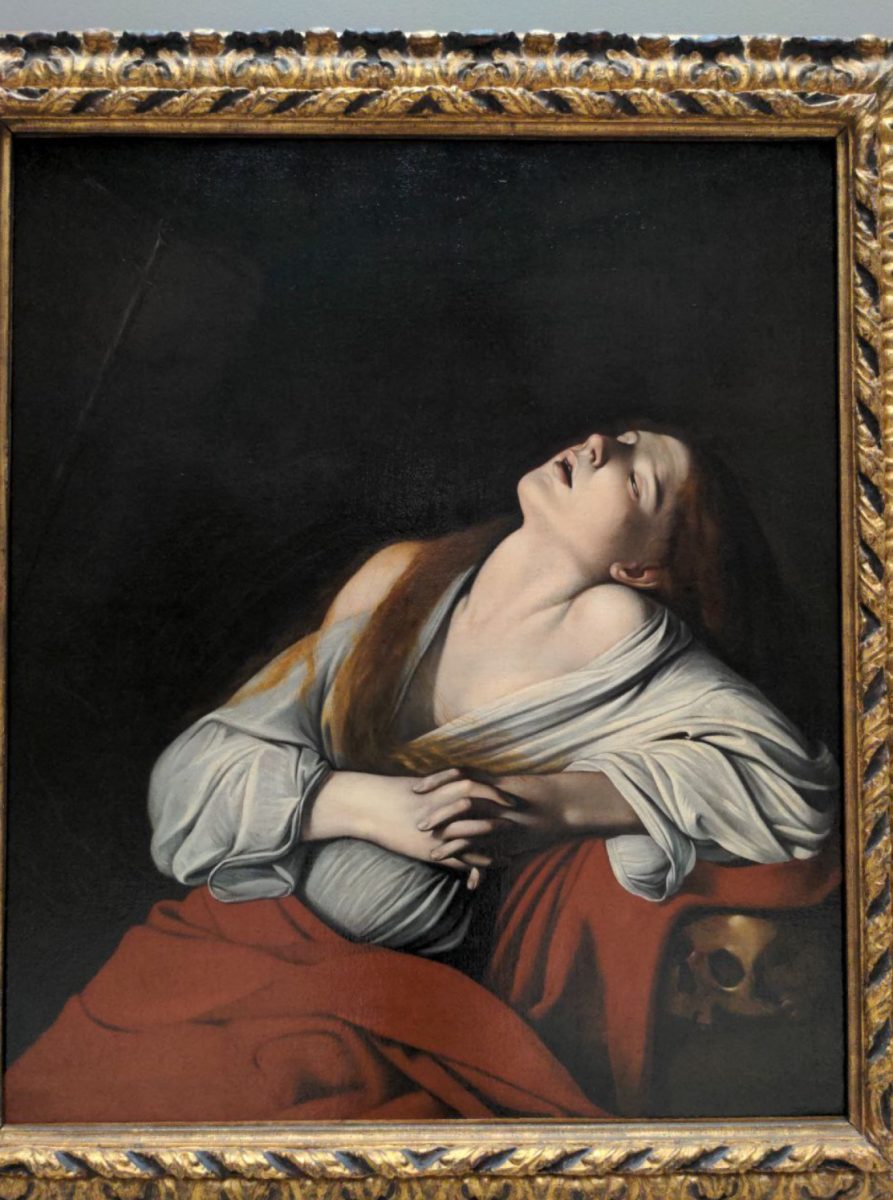
It is Myshkin in Dostoevsky’s “The Idiot” who once said that “beauty will save the world.” Far from being merely a function of human pleasure, as a reductive hobby for the highbrow critic, most can admit that art is often a language for philosophical inquiry and the fire which kindles idealism, saving souls and states.
For instance, under the guise of an early 19th century portrait of two women’s display of tenderness and sorority, Italia und Germania (Italia and Germany) by Friedrich Overbecker was an allegory for Italy’s risorgimiento (literally “the resurging”, the artistic and political desire for an unified Italian nation) and Germany’s unification campaign. The two had been an amalgamation of loosely connected kingdoms at this time (especially the German states whose cartography resembled the erratic streaks of a Jackson Pollock painting), and out of a feeling of a common cultural history each respectively sought to consolidate their many regions into one state.
Though it had not been until the Prussian campaign for German unification by Chancellor Bismarck (1871), the total culture of the Germanic states in the politically-inefficient and disjointed Holy Roman Empire was tangible enough that it may be differentiated from, say, Swiss-Savoyard culture. For instance, both the monks of the provincial Mainz and the bureaucrats of Kholn culturally benefited from the Niebelunglied poetic epic (1200 AD), for the 1200-line myth made Germany the matter of heroes, regardless of region or dialect.
The same can be said for Italy, whose matter of literature has consistently prided itself on steadfastly using local dialects, during a time when most serious artistic, scientific and political endeavours were in Latin and local dialects (such as Italian) were considered vulgar: a convenient language for daily conversation but futile for furthering discussion in the then-discovered world.
For example, Petrarch chose to write his Canzoniere (“songs”, a rather simple collection of love poems) in Italian, but wrote his epic poem Afrique in baroque Latin (it was common to emulate the ornate techniques and quirks of the Roman authors, who preserved only “the best”). Serious political desire for an Italian state is said to begin at the signing of the Treaty of Campo Formio by Austria after their defeat by Napoleon in Lodi, which established sovereignty for Austria’s Northern Italian territory as the Ligurian Republic (De Clercq, Article 11 of the treaty). Though artistically, the idea of the Italian spirit was conceived as far as the Renaissance at the time of Petrarch, begot by the shared artistic material of Rome’s myths.
This elaborate dissertation on the artistic movement of the Italian unification has a twofold purpose in the exploration of aestheticism. Is the profuse use of artistic technique, such as by the complexity of conditional suffixes and arcane Latin vocabulary, objectively better than ditties written in the language of the cobbler and milkmaid? Or can Dante and Vergil traverse the corridor of souls together, each gilded by their own respective style?
Secondly, is the value of art measured from an utilitarian standpoint: must a work bring about the reform of a state or one’s virtues to be more than the fancy of fleeting passions?
In response to the first, it is evident by intuition that there exists qualitative parameters by which art is pleasant or discordant. Within the visual mediums, there exists the idea of kinetic aesthetics, which is perception according to the knowledge of our own body (Lundh). For instance, cathedrals are natural conduits to the sublime experience by the coordinating ascent of our eyes seeking the top of spires and the cascade of tripartite aisles.
Further, the musical modes of keys can only be interlaced so far that they become a tangled web rather than a symphonic tapestry. Musical theory is in essence application of mathematical models of pitches and yet little technical knowledge is needed to know that notes of a song clash, the timbre of an instrument scarring to the ear. The concept of harmony is palpable by intuition to the ear, eye, and mind. In short, there is no need to be aware of a song’s use of the dorian mode (a scale that separates four-note segments by a whole tone); no philosophical analysis of a piece’s leitmotifs (the association of a musical sequence with an idea) such that knowledge of how Wagner’s Brühnhilde motif is understood to represent joy (Carter) is unnecessary for the enjoyment of Tristan and Isolde.
Yet the impetus of art is its appeal to the qualia, those passionate inclinations which we can neither attribute a specific experience to, and logic can only be used as a justification after the matter. For instance, despite the assertion of neuroscientists that there will come a time to explain the existence of individual subjectivity, there is as of yet no proper scientific explanation for why one despises coffee as a sour atrocity and another finds the same substance (with the same amount of sugar, milk, etc.) as pleasing to the taste. There is little active cognition performed for us to intuitively assert that we like a painting, anything after is a discovery of the subconscious process.
Such that, it seems when the assertion is made in passing at an art gallery that a painting is wonderful, it is only when asked to justify that love that an analysis is made concerning its composition and masterful contrast. Following the surplus value theory, effort (which is quantifiable) seems to be intuitively a measure of art’s value. Taking justice as fairness, it does not seem just for us to accept that a decade-long effort to paint the roof of the Sistine Chapel is of equal value to the quick splashing of a paintbucket.
Simply, art seems to be the science of appeal to the indescribable humanity, while empirical measures seem better suited for statistics. “We’re subtracting the beauty of [art], in which it allows us to express things that are not quantifiable, […] Da Vinci talked about the mathematical proportions of people and stuff like that. And I think there, you can find beauty in lots of things and certain people, but certain things are going to be more appealing to others. Some people think some flowers are more beautiful, and mathematically, they might be different, but those same flowers to different people are going to be the same amount of beauty” senior Ruby Thier said.
Finally, besides the technical measures of art’s value, there also exists its practical value. Senior Saharat Sreearayanpong also valued the medium of comics immensely. When asked which book he would save from a hypothetical destruction of literature, he chose his prized collection of “Calvin and Hobbes” comics. “First of all, it has humor which is something you need. Second, it includes some philosophical enquiries and critiques of the Cold War, which is all you need in a book,” Sreearayanpong said. Perhaps the great works condense truth and pleasure, appealing to our world-view and our desire for its association with palpable enjoyment.