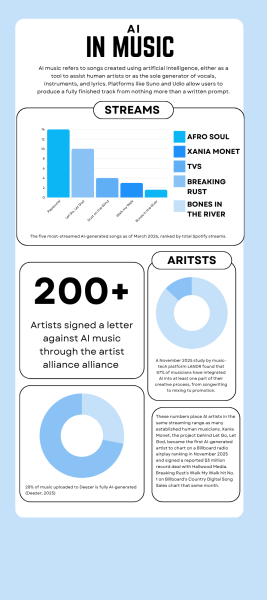
Artificial intelligence has already disrupted writing, art, and customer service. Music is next. Recent studies have shown that AI can now generate songs convincing enough that 97% of listeners cannot consistently distinguish them from human-made content. AI-generated artists are bringing in millions of streams, and in 2025, the Recording Academy awarded a Grammy to a song made with AI for the first time in history.
A Grammy win may establish a turning point
In 2025, The Beatles’ “Now and Then” won Best Rock Performance at the Grammy Awards. The song was assisted using restorative AI techniques to isolate and clean up a demo recording made by John Lennon before he died in 1980. Now, it is the first known AI-assisted song to ever win a Grammy, making history.
The win will now be significant because it signals that the music industry’s most prominent institution now recognizes AI as a legitimate part of music production, specifically for restoration and assistance. Since the Beatles did not use AI to generate new lyrics or melodies, they used it to clean up audio that was already human-made. This distinction between AI as a tool and AI as a creator is at the center of the debate now in studios and streaming platforms.
To test how identifiable AI music is to typical listeners, The Tide played an AI-generated song, A Million Colors by Vinih Pray, for two members of the school community without telling them how it was made.
Junior Ganesh Ramamurthi, a member of the school’s Chamber Choir and a cappella group Resonance, was the first to listen. He said the track sounded indistinguishable from songs he hears regularly. “It sounds normal,” Ramamurthi said. “Like I could hear it on the radio. It could show up on my, like, my mix or whatever. It doesn’t scream like it’s AI.” He noted that some lyrics sounded “a little jumbled,” but said he would not have immediately suspected a computer made it.
Chorus Teacher Mrs. South has a similar reaction when played the same song.”Catchy, soulful and comforting,” Mrs. South said. She explains that it felt familiar because it was “modeled after so many great techniques and styles of the past.”
Both reactions support the broader research finding on how AI-generated music is now sophisticated enough that it can pass an information listening test, even with people whose daily lives are built around music.
Is it a tool for artists, or a replacement?
The growing use of AI in music falls into two distinct categories: assistance and creation. Established artists have used AI to clean up old recordings, repair damaged audio, and complete unfinished works. Programs like iZotope RX and Sony’s MAL technology, which was used on “Now and Then,” can isolate vocals from decades-old tapes, allowing producers to restore tracks that were once not posted to the public. For artists with disabilities or aging voices, AI can help their careers if they face physical limitations.
The other category is generative AI, which can produce songs from just a text prompt. Platforms like Suno and Udio allow users to type a few sentences and receive a fully produced song in seconds with complete vocals, instrumentation and mixing. Songs made this way require no musical training, no studio time and no other people. This is the form of AI music driving the streaming numbers and raising the most concerns among working musicians.
The question of these ethics is increasingly difficult to answer. Even producers see AI as a tool, as they say they look forward to seeing how it will earn its place in the studio, since usage is still unknown.
That uncertainty is something listeners are beginning to feel as well. “I think as AI progresses, it will get more difficult [to tell the difference],” Mrs. South said.
The economic threat to working musicians
The most immediate impact of AI music is financial. A 2024 study commissioned by CISAC, the international body representing songwriters and composers, projected that generative AI could cost human musicians up to 24% of their revenue by 2028, with a loss of roughly $10 billion annually across the global music industry. Streaming royalties, licensing fees and session work are all at risk as AI-generated tracks fill playlists, background music libraries and advertising slots that human artists once relied on for steady income.
This concern is shared by music educators and performers who see AI as competition that can replace them. Unlike past technological shifts in music, the rise of synthesizers, autotune or digital sampling, AI does not require an operator with skill or training. All AI requires is for someone to type a prompt.
A new genre
An interview argues that AI music will eventually settle into the broader landscape as just another category, the way electronic music or hip hop did before it. AI-generated music will not destroy the industry, but will instead create a new market segment, particularly in functional music-background tracks, study playlists, meditation soundtracks and stock music for video content.
This perspective treats AI music as an addition to the industry. Listeners who want human-made music will seek it out, and listeners who simply want a pleasant sound to fill the silence may not care who, or what, made it.
“Music is, in my opinion, about how it makes you feel, and it’s about evoking emotion in the listener,” Ramamurthi said. “So, regardless of who made the music, if AI music ends up having that effect on somebody, I think that that makes it equally as valid as music that was made by, like, entirely by a human artist.”
This prediction depends largely on transparency. If AI music is clearly labeled, listeners can choose. If it is not, the choice is taken from them.
“Some people listen to pop, some people listen to reggae, as some people will listen to AI music, and that’ll resonate with some people, and it won’t resonate with others. And I think that’s all right,” Ramamurthi said
Who owns an AI song?
Beyond the financial impact, AI music has created a legal problem that the industry has not solved within intellectual property. Traditional music copyright protects the songwriter, the performer and the producer. AI-generated music can complicate this. The question of who actually owns a song made with AI, the user who typed the prompt, the company that built the AI or the artists whose work copied it remains largely unanswered.
In 2023, the U.S. The Copyright Office issued guidance stating that fully AI-generated works cannot be copyrighted because US copyright law requires human authorship. The Office has since reaffirmed this position, ruling in 2025 that prompts alone do not provide sufficient human control for someone to claim authorship of an AI-generated work. A federal appeals court upheld the same principle in 2025. The line between AI-assisted and AI-generated is blurry, and most generative platforms like Suno and Udio are trained on enormous amounts of copyrighted human music that often come without the original artist’s permission. Major record labels are currently suing both Suno and Udio for copyright infringement.
“The question the music industry has to ask themselves when we’re using AI in music is something called IP—Intellectual property, which determines your credibility. So how are you going to copyright AI music if you don’t know who’s creating that?” junior Chamber Choir and Resonance President Aaron Swibel said.
Swibel pointed out that the source of an AI-generated song is fundamentally different from a song written by a person. “Is the prompt creating that music or is all of the sources that AI is using?” Swibel said. “What intellectual property do we have to credit when we create music with AI? And how can that lead to music with no monetary value, with no credit to anyone?”
He also said that learning that a song was made with AI changed the way he heard it. “It changed how I feel about the expression of the music, because there’s no creative thought behind it. Someone didn’t have an original idea that was putting meaning behind the melody as it’s just a generated melody. So it makes me question the emotional depth and the creative process.” Swibel said.
What comes next?
AI music now lies in a gray area. It can win Grammys when used as a restoration tool. It can generate millions of streams when used as a full creator. It can pass for human-made music in informal listening tests, and it can debut on Billboard charts before listeners even know an algorithm produced it.
What remains undecided is how the industry will respond. Streaming platforms have begun taking different approaches. Deezer now flags AI-generated tracks on its platform and reports that roughly 28% of music uploaded to its service is fully AI-generated, with around 10,000 AI tracks submitted daily. Spotify’s policy is more limited, removing only AI music that impersonates real artists. The Recording Academy has updated its eligibility rule to require “meaningful human creative authorship” for Grammy consideration.
For now, the technology continues to grow faster to keep up with these systematic rules. Until disclosure standards become consistent across platforms and copyright protections catch up to the technology, the responsibility falls on listeners to decide what they value in the music they stream.
If you would like to voice your opinion on an issue you feel is relevant to our community, please do so here. Anyone is able and welcome to submit a Letter to the Editor, regardless of journalistic experience or writing skills. Submissions may be published either online or in a print issue.