Q: How are you preparing for AP and IB testing?
Mr. Goetz: With lots of regular problems, and then AP and IB style questions. I mix in reviews starting in February. So we’re doing a cyclical review of previous topics, and then using a lot of old exams, old mark schemes, to see where people can get points, and then go through strategies, usually the week before the test.
Mr. Grosfeld-Katz (Social Studies Teacher): Mostly we just review the material we’ve covered earlier in the year. We hopefully have some fun review games, so that studying doesn’t seem like so much work. But of course, also trying to get the students to study. And it is hard for students to study because it takes time and effort, but I’m trying to show them that it’s important and that it’s more for your learning. I don’t like teaching just so students can take a test, I want students to learn the material forever.
Mr. Montalvan (AP Psychology, IB Anthropology Teacher): How do we prepare? We do brain dumps, retrieval practice and they have quizzes in the AP classroom. They have practice tests in the AP classroom. The school has purchased albert.io so they have tons of practice quizzes and tests that they have access to. And taking many practice tests and quizzes is a great way to study for these AP exams.
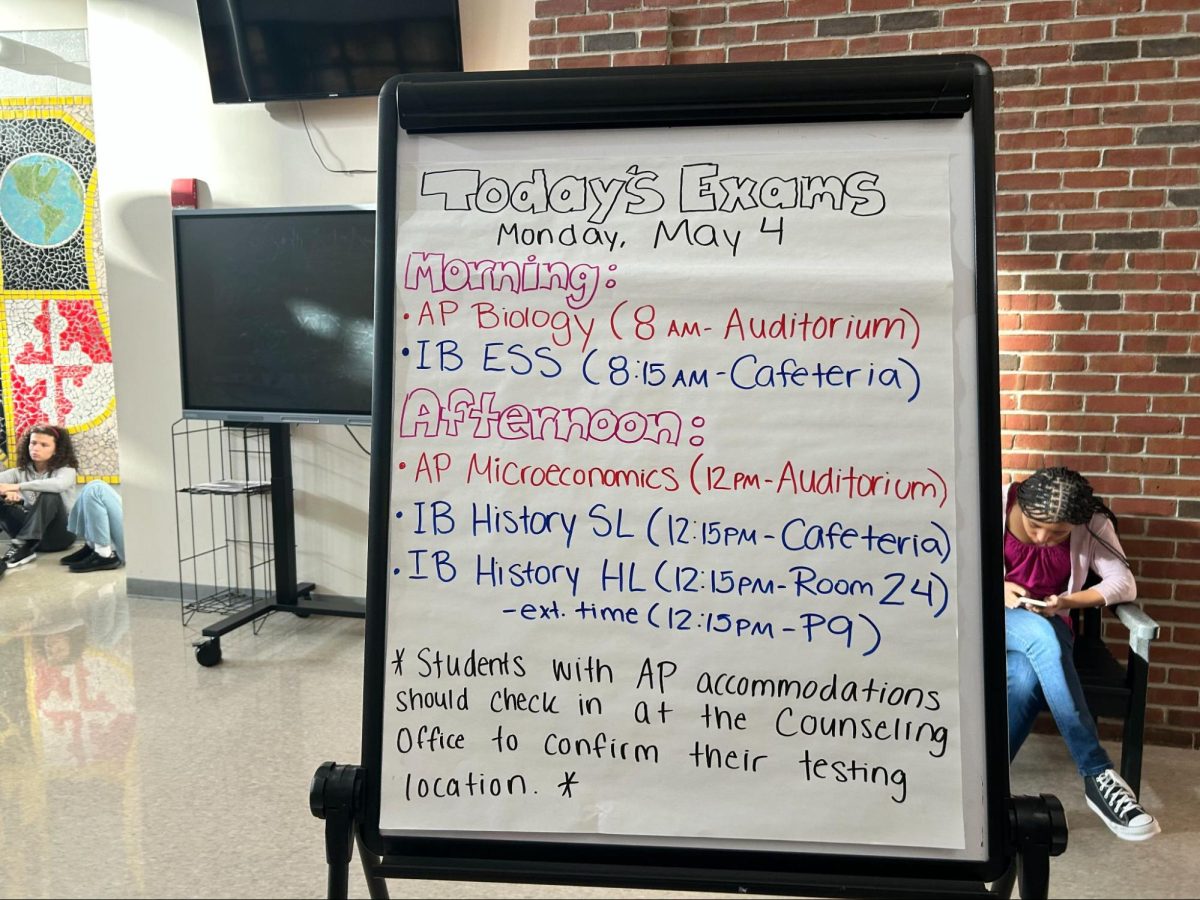
Ms. Britch (IB Office Secretary): We start preparing for exams as early as July, so as soon as we have the schedule for the exam season, we’re meeting about which exams are going to be held in which rooms. So we like to get really ahead of the game. By the time registration is done and we have the numbers, we go back and revisit which rooms we use for each exam. We have testing boxes that we go through, and we make sure that we have enough materials purchased. We make sure we assign enough proctors for all of the exams. We touch base with the AP coordinator to make sure that we’re not trying to all use the same rooms at the same time. We get the auditorium ready with all the ready desks, and that takes a lot of effort and energy. We make sure students know what’s going on, so we’ve already sent every student their full exam schedule, and we make sure it’s posted on the website.
Q: Is this time of year usually stressful for you?
Mr. Goetz: Yes, because I want my students to do well. I want them to be prepared. It’s particularly tough because you’re doing mock exams, trying to grade them and get them back quickly. So I’m sure many AP and IB student teachers feel the same way.
Mr. Grosfeld-Katz: It’s not stressful for me, because I’m not the one taking the exam. But also, I still think that the learning is more important. So if a student leaves my class and feels like they learned something and can apply what they have learned, then I feel good. And you know, I’m not going to worry too much about a test.
Mr. Montalvan: No, not really, because you know, we’ve done our job at this point. Now it’s on the students. For me personally, you know, I’m good.
Ms. Britch: So this is my third or fourth year helping with AP and IB exams, and I feel like we have a really good process in place where nothing really is done last minute and nothing is forgotten about. I keep really good notes of what needs to be done and at what point of the year. We’re extremely organized, and I think it helps us get ahead of the game with a lot of things.
Q: How does your prep usually vary from year to year? Is there anything you change and tweak?
Mr. Goetz: I usually read exams, and the exams evolve over the years. When there’s a huge revision, go through all the changes. So the last two years, IB physics and AP Physics went through big revisions. So it’s been a really busy two years, trying to incorporate a lot of things into class throughout the school year, not just at the end of the year. But I enjoy that. I enjoy thinking about different strategies of how to see styles of questions. I like trying to get students to be able to approach content better and use their critical thinking.
Mr. Grosfeld-Katz: I don’t think my style varies from year to year. I might try to come up with some new materials or new games or new news articles to reinforce what we have learned, but my style of combining games and work and the methods that I choose, I don’t think those have changed very much.
Mr. Montalvan: For the most part, it’s fairly consistent in terms of what I expect students to know and complete from brain dumps and retrieval practice to online quizzes in class. Sometimes we’ll vary it up with online games. We tend to keep it light and fun so it doesn’t feel like it’s too stressful. Sometimes if they get a question right, I’ll bring in a mini basketball, and they can take a shot for an additional point or prize and things like that, but for the most part, some variation of review.
Q: What are your opinions on standardized testing?
Mr. Goetz: I’m a fan of it within a reasonable amount. I think it is a metric that probably does have some value, especially with grade inflation nowadays. Obviously, in the bigger picture, I think that it shouldn’t be a defining and sole characteristic when evaluating the strength of a student. I think a while ago, it was like, ‘Oh, well, we are only taking you if you have an SAT 1400 or above. You have to get that or you’re not getting in. That’s kind of silly. But I think the difference between someone getting a 900 and someone getting a 1300—that’s pretty stark, especially if it’s taken multiple times.
You do have some people who have more resources than other people, so you can certainly raise your score with that. It is biased towards people with more money, because they can get tutoring and have the time to practice.
It is also a good life skill to have. People go to grad school, they take the GMAT or the LSAT, like, standardized testing is not going away. So why would you not practice it now?
Mr. Grosfeld-Katz: I can tell you that I do not like the idea of classes that are just geared for students to take a test or for students to take a class for a test, or for teachers to teach a class for a test. School should be about learning material that you keep for your lifetime, and so as far as end of year tests go I suppose they are important, but unfortunately, a lot of people forget what they’ve learned after the test anyway, so I’m not sure how effective a test is at encouraging students to really learn the material. So my feeling about standardized tests is they probably have some usefulness, but I wouldn’t mind a world with fewer tests.
Ms. Trivers: It’s a necessary evil. I think that it’s important that students have some common expectation across the country that they’re meeting so that you can just make sure that everyone’s getting the same experience, taking the same course. So I don’t love it, but I do think that it is necessary, and a good way for students to really demonstrate what they’ve learned.