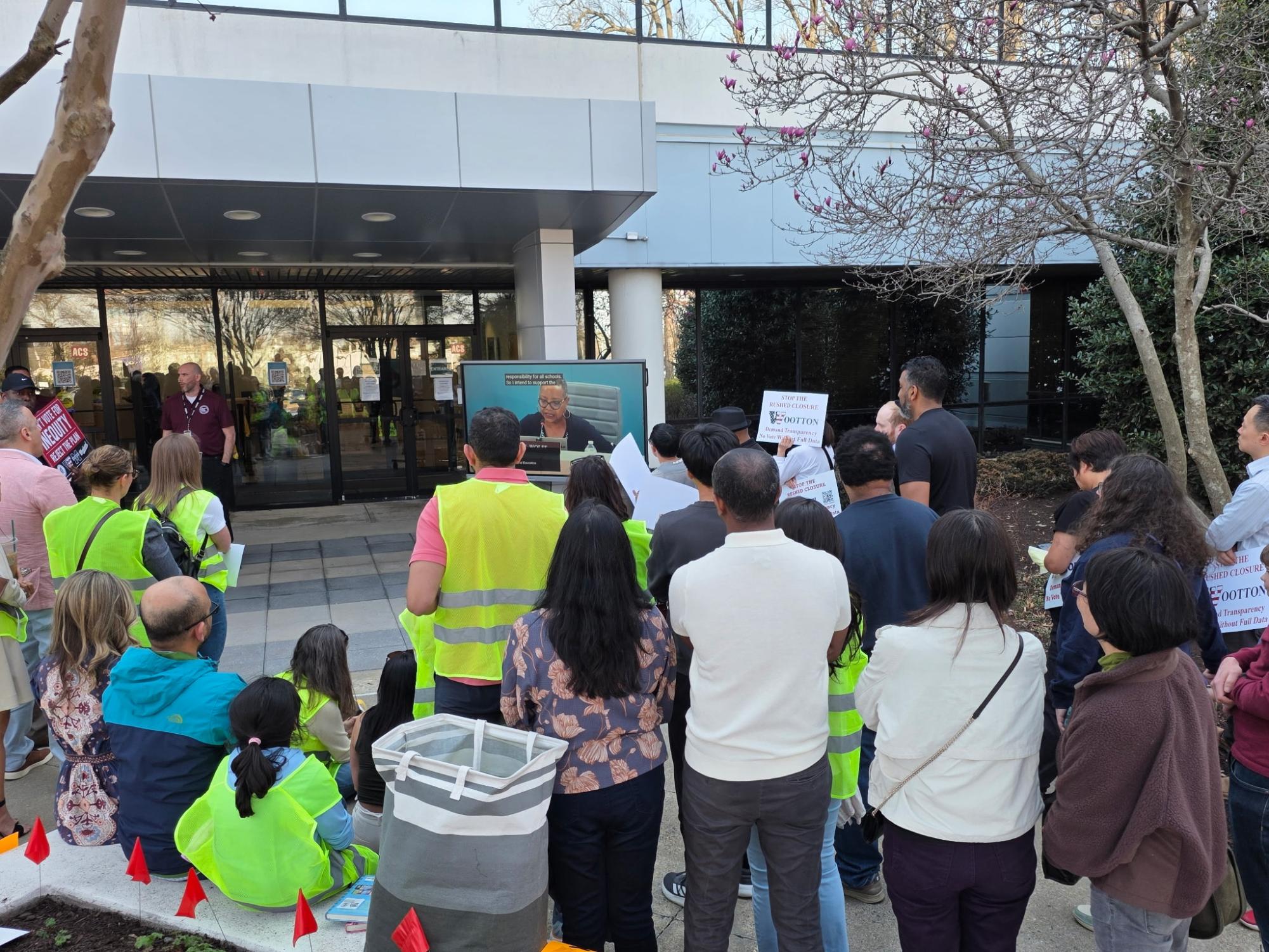
Montgomery County Public Schools has faced backlash over a 7-1 decision in favor of controversial redistricting policies that affect families all over the county. These policies affect the local magnet programs as well, with MCPS deciding to implement a regional model system which will split MCPS into six districts, with students applying to magnet programs within their district.
MCPS currently hosts several county-wide magnet programs, including Montgomery Blair High School’s STEM program, Richard Montgomery High School’s International Baccalaureate (IB) program and Poolesville’s Global Ecology, Humanities and STEM programs. These programs are extremely competitive, with students applying from all around the county for a limited number of seats. However, many MCPS Board of Education members pointed out racial discrepancies amongst accepted applicants, with around 75% or more of students in these programs being Asian or White.
According to the Board of Education, these statistics indicated that the MCPS magnet system underrepresented African-American and Hispanic populations, which meant the best course of action would be creating more programs for a smaller pool of students.
Even though seven Board of Education members voted to pass these policies, one member, Julie Yang, stood out from the rest. In her reasoning for her decision, she stated her belief that “the regional program resolution and the boundary studies reflect important and necessary goals.” However, she then stated that the county may not be taking the right balance or time to fully implement these goals, comparing their actions to “flying the plane while building it.” She acknowledged the decades of effort poured into implementing the magnet programs and their national recognition. In order to pass this policy, Julie Yang urged for metrics on quality control and an evaluation matrix to define success for this new policy.
Julie Yang is one of many Montgomery County leaders, students, parents and staff who feel this way. Rockville Council Member Adam Van Grack explained that he was a Richard Montgomery IB alumnus and that his “education at Richard Montgomery was as good as it could have been, because he was able to take advantage of the International Baccalaureate program.” He then went on to express his agreement with Julie Yang on how “the regional program has good endeavors.” He expressed his admiration for their goal to create more programs for students around the county. However, the main issue for him was implementation. He agreed with Julie Yang on how the IB program and other MCPS programs are doing well. Yet before MCPS makes changes, he wants to make sure that the county is not losing the successes that they had before. This was his main concern – that MCPS programs could be weakened if they rushed too quickly.
Along with Adam Van Grack, Rockville Council Member and Richard Montgomery parent Barry Jackson gave his perspective. In response to our question about the regional magnet model, he expressed his “hope that if the school board goes to a regional model, that they really have data to show whether it is working or not, and if it doesn’t work, they’re open to returning it to the way it was.”
Jackson also elaborated on how these changes may affect the Rockville community as a whole, with several ways in which the Rockville community could be majorly impacted by this policy change.
His first concern was the logistics problem that would be created for students living near Thomas S. Wootton High School, a school in Rockville, Maryland, with around 2,000 current students. “There’s not going to be any more walking to school if you live near Wootton High School,” he said. Instead, people will have to be bussed to school, because they would otherwise have to cross Highway 28 and Shady Grove Road to walk to the new Crown High School, which he believed would be difficult for many students.
Another concern is primarily economic, with many developments in Rockville counting on, in part, business from students and parents who go to Wootton, which will not be present after the closure. “[The city of Rockville] “already had a commercial interest in the new Rockshire Development saying that they don’t want to move in,” Jackson said.
Moreover, the decision could have broader implications for Rockville’s future development. Rockville’s Adequate Public Facilities Ordinance (APFO) states that houses cannot be built if there are not adequate schools for said houses. This has prompted concerns for the Rockville Town Council, especially with regards to Wootton’s closure. “By closing Wootton High School, MCPS might be choking off growth in the city of Rockville, because they might trigger the city’s ordinance,” Jackson said.