“In the summer I could be practicing upwards of six hours a day,” senior Zack Lam said. As a pianist, he has won 45 international competitions and been invited to perform at various places including Carnegie Hall and Beethoven’s estate in Germany. Out of a myriad of talented musicians at RM, there are a few high-achieving students who have worked diligently to get to where they are today.
Thanks to the fantastic music programs at Richard Montgomery, many students are able to become wonderful musicians. “Every one of those ensembles that I talked to you about earlier is as much a team as any team that we have here in the school,” Dr. Peter Perry, RM’s instrumental music director said. Through the RM music program, in addition to their relentless practicing and pursuit of betterment, students gain a skill set to continue to improve in music throughout high school and onwards.

Musical talent can be innate, but true excellence is made through rigorous, dedicated hours of practice. For these high-achieving musicians, practice is not a casual hobby but a structured, demanding part of their everyday lives. While motivation may come and go, the discipline is constant. “Every day I try to spend at least one hour on each instrument. And if that doesn’t happen, then I try to do a little bit extra the next day,” freshman Chloe Robertson, who plays violin and bassoon, said. Her routine sets two hours of work as a baseline—already more than what many would spend on homework.
However, this number can skyrocket during audition and competition seasons, as junior Aaron Hwang, a cellist, describes. “[My practicing is] basically just as long as I can. Sometimes I stay up to one or two practicing.” Hwang said.
However, their success isn’t just measured in a quota to obtain–rather, it’s about strategic structuring and organization. “Recently, I’ve tried to do a back and forth routine where I practice for 30 minutes and then do homework for 30 minutes and then keep doing that,” junior Oliver Lin said. The format of a practice session is almost as important to the musician as its duration, which is why techniques like Lin’s that allow the musician to stay focused are so useful.

Hwang says that his practice routine typically involves 30 minutes of scales, 20 minutes of etudes, and as much practice of audition material as he has time for. A structured system for practicing allows these talented musicians to make the most progress possible in the limited number of hours they have in each day, maximizing results.
Ultimately, this commitment is fueled by two key motivators working hand-in-hand: An unwavering commitment to, and a lifelong love for, music. “[Whenever I’m not motivated] I just think about my dream schools or my dream jobs. And I say to myself, if I keep up this attitude and if I keep up not prioritizing what I need and not practicing, then my big goals will probably not come true.” Robertson said. These students’ love for music, combined with their college dreams, typically inspire them to want to continue their musical studies in college. “I’m actually not really sure if I’m majoring in music yet. I’m considering a double degree or double major.” Lam said.
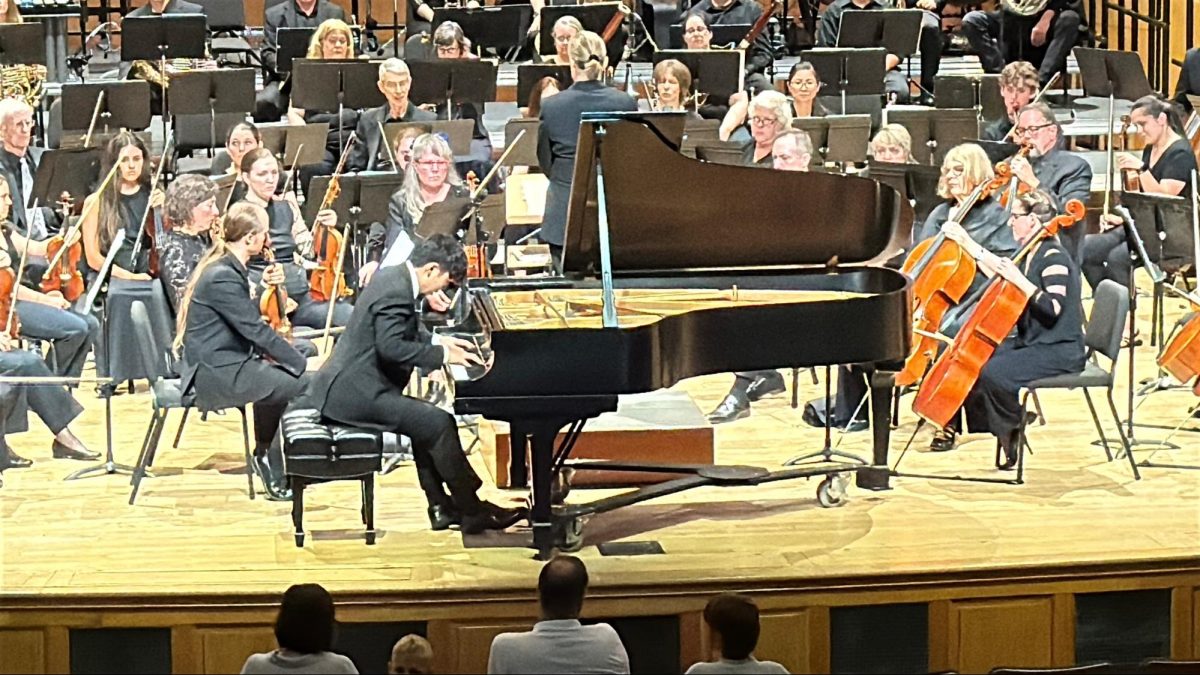
Though many students’ talent, hard work and impressive dedication take them far from home, the diverse and talented community that is RM Music is nothing to disregard. “Any one of those ensembles that I talked to you about earlier is as much a team as any team that we have here in the school,” Perry said. The school pride that RM musicians embody creates a sense of community among its members, which Hwang says may be rarer among private, more selective groups that require an audition.
These selective ensembles may attract some of the best and the brightest musicians from the area, but such a high concentration of similarly-abled performers may become a disadvantage. “I would say, the [RM] community is good. It’s nice to know people in different grades and at different skill levels, because there’s such a wide variety of people that you meet. In other ensembles, it’s a lot more about age, or skill level,” sophomore Liliana Schuster, a viola player in both RM’s Chamber Orchestra as well as the Maryland Classic Youth Orchestra and Maryland All-State Orchestra, said.

The diversity within the performing arts community at RM is one of its many strengths. “There’s that stereotype of band kids, right? And I realized that the stereotype is pretty true, honestly,” Lin said. “The people there are pretty weird, but it’s a good type of weird in that you’re able to feel you’re part of the weirdness because it’s such a strong community.”

For many students, music has become their main form of expression and a way to share their passion with others. “Music is just a way to express yourself in a way that not everything can. And the amount of work you put in will reflect that” Hwang said. Hwang says playing music is one of the only things that he is good at, which fuels his passion to be great.
Many student musicians say that music’s ability to release emotions and express oneself is integral to its allure, something to which few other areas of study can relate. Lam says that humans are highly complex, and not every emotion that a human being may feel—such as those that arise from music and art—can be described with language.
“I think that if we raise a society of mere scientists and engineers without any kind of education in the humanities, the arts at all, what we’re essentially doing is setting ourselves up for failure, because we’re setting up a generation without the moral sensibilities nor the ability to express themselves that a successful and prosperous and kind and empathetic society really needs,” he said.

Many students give up academic pursuits to fully commit to music. Robertson said that she is looking to increase her practicing rigor, and as a result does not plan to take many AP or IB classes throughout high school. Her dedication to music means that she must choose classes with lighter workloads to fit in her demanding practice schedule. That being said, she is still dedicated to school and hopes to get a high GPA and SAT score in addition to her music.
Other students view things differently. “I do tend to prioritize school work over music, just because obviously, school comes first,” Lam said. “I would say, generally, I’m pretty efficient with my time. I get my homework done within about two hours, which leaves the rest of the evening for me to do other things.” His choice to keep up with the rigor of IB on top of his heavy practice schedule means that he must constantly stay organized and manage his time well.
Ultimately, through their music, these student musicians are also growing as individuals. “There a lot of music students who are developing. Typically, the development happens not necessarily musically as much as it happens a maturity standpoint,” Perry said. “They develop as people, become better at engaging with each other and the other people in the ensemble.”
If you would like to voice your opinion on an issue you feel is relevant to our community, please do so here. Anyone is able and welcome to submit a Letter to the Editor, regardless of journalistic experience or writing skills. Submissions may be published either online or in a print issue.