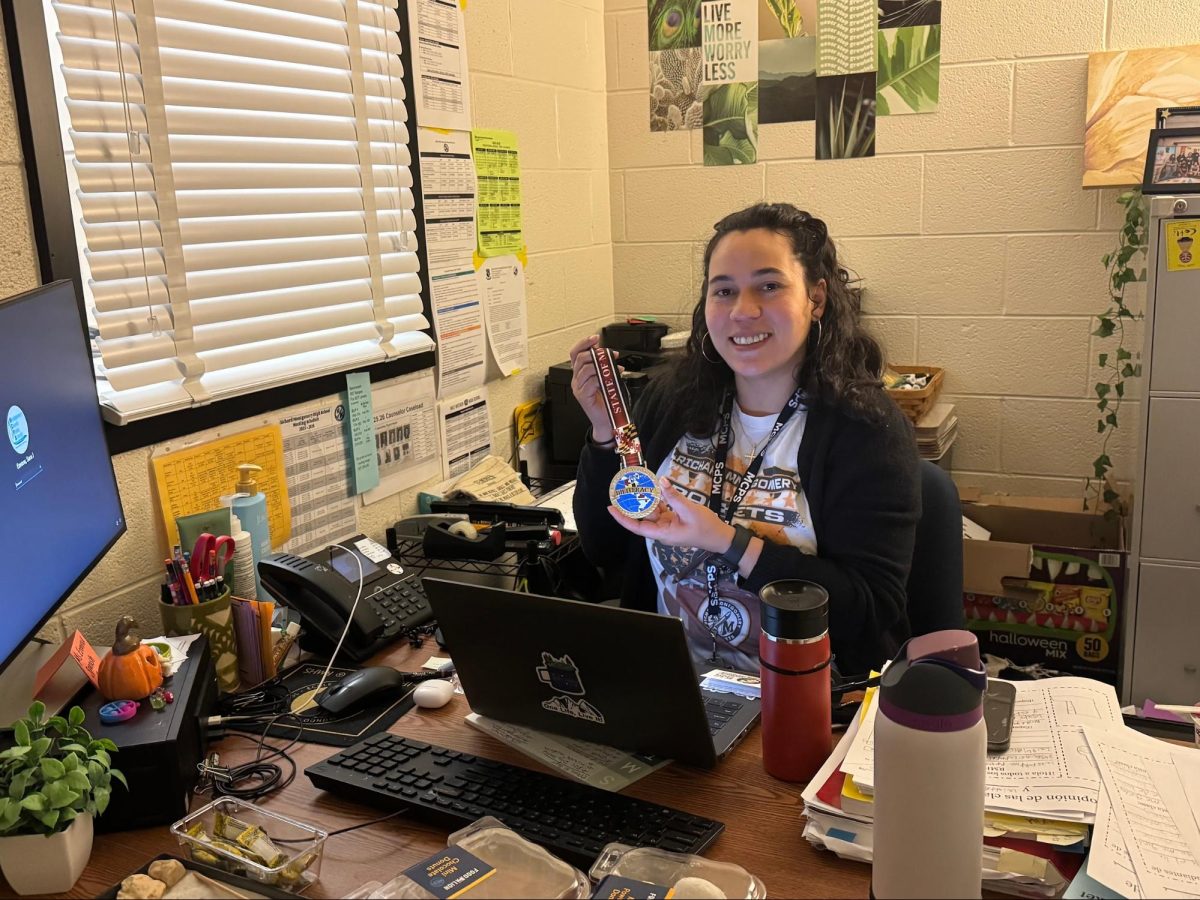
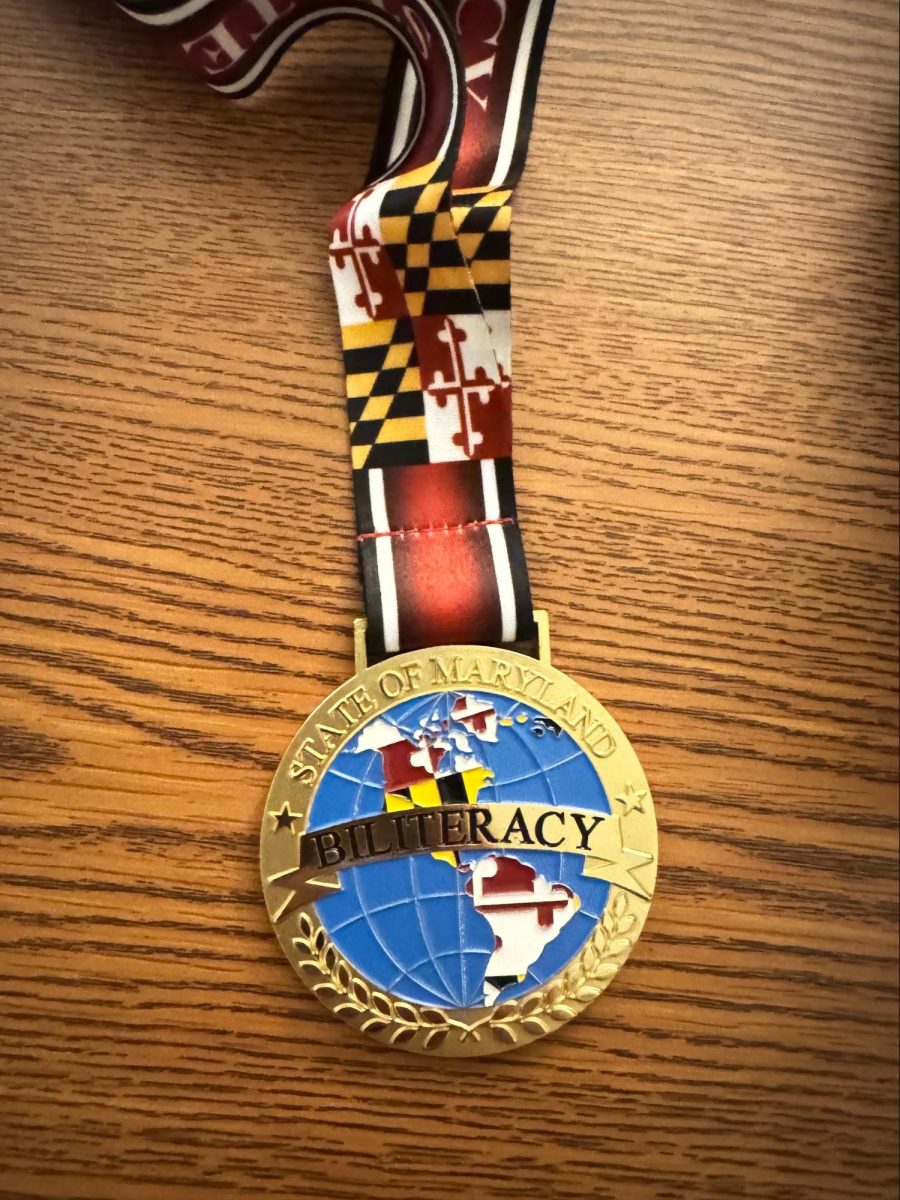
Every year, hundreds of students at Richard Montgomery and thousands throughout the county earn the Maryland Seal of Biliteracy.
The Maryland Seal of Biliteracy is an award given by participating public school systems that recognizes a student’s high level of proficiency in listening, speaking, reading and writing in one or more languages other than English, per the Maryland Department of Education. Many language teachers agree that earning the Seal opens many doors for students and helps them connect to a culture different from our society. It helps them become more well rounded and demonstrate their efforts in learning or speaking a second language.
A student can test for biliteracy in practically any language. There is the Avant test for earning the Seal of Biliteracy, which has 55 languages that a student could test in. They can also earn the Seal through taking an IB or AP exam, which expands the number of languages as well. “Furthermore, if there’s a senior that has a language that is less commonly spoken, for example, our students that speak Sinhala, that language is not offered by Avant,” Spanish teacher Sara Ezeonu said. “But the county, if they’re a senior, will pay for them to take a separate exam called the ALTA exam … So [the number] seems almost limitless.”
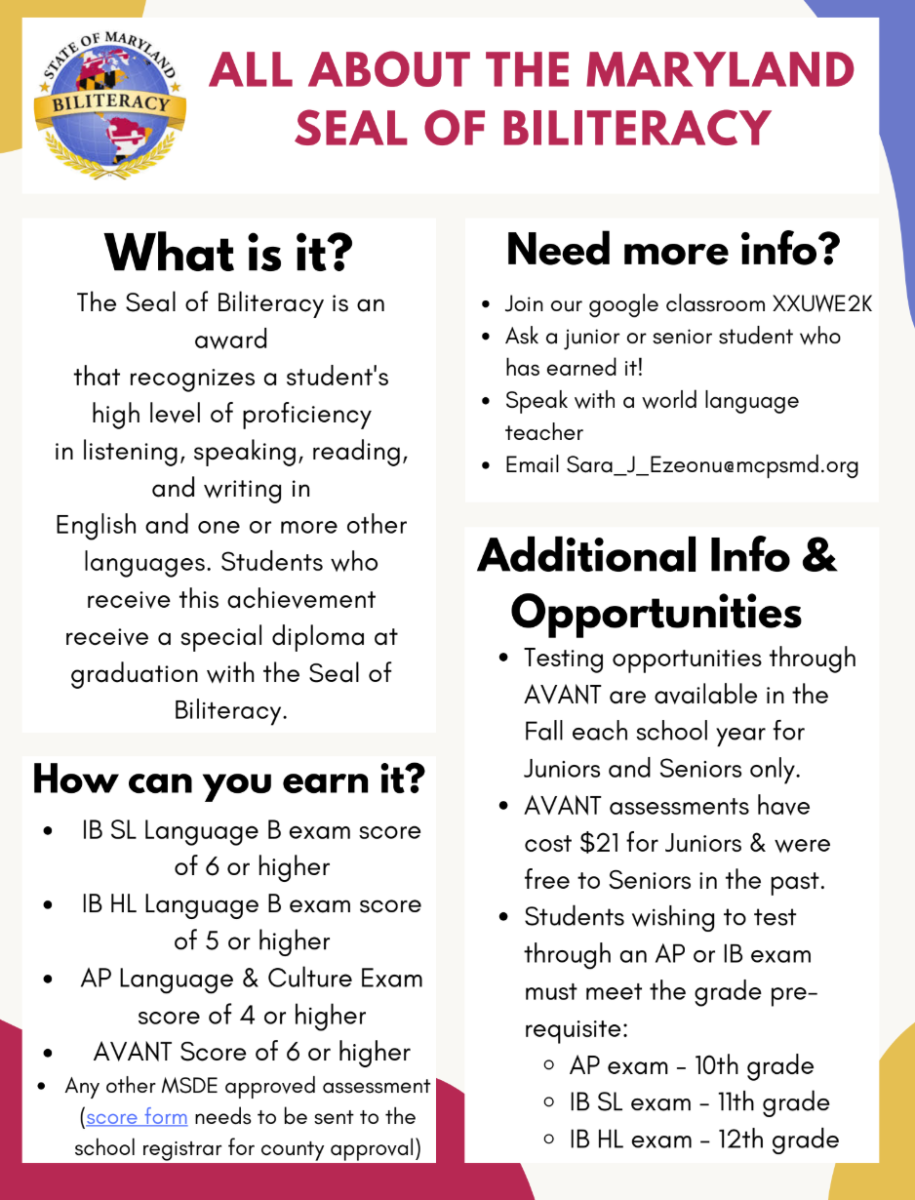
There are six ways to earn the Seal of Biliteracy: The AP exam, the IB standard level (SL) exam, the IB higher level (HL) exam, the Avant assessment, the ALTA test or a test outside of MCPS that would need to be approved. To earn the Seal, a student must score a four or above on the AP exam, a six or above on the IB SL exam, a five or above on the IB HL exam or score “Intermediate High” or higher on the Avant assessment or the ALTA test.
All six of the exams test the four components of knowing a language—reading, writing, speaking, and listening.
The Avant exam offers 55 different languages for students to test in. They do not need to be enrolled in a language course in order to take the test, but they do need to be able to read, write, speak and listen to it. There are two test dates per year, one in November and one in January. The assessment is all electronic, and there are sample tests provided so students can get accustomed to the structure of the exam. There are different rubrics for the many languages offered for the Avant assessment, which are available in the Seal of Biliteracy Google Classroom, which is accessible from posters pasted around the school and the Seal of Biliteracy Interest Meeting slideshow.
The assessment is scored based on a student’s proficiency level, on a scale of one to nine. Novice is a score of one to three, intermediate is four to six, and advanced is seven to nine. So scoring a six means that a student is scoring at intermediate high on the scale of different proficiency levels that they could earn. Using this scale, the highest a student could earn on the Avant assessment is a nine, or “advanced high.”
The ALTA test is done outside of the county, and requires payment. It offers various proficiency tests for over 90 different languages, including rare languages not offered by the Avant assessment, such as Georgian or Sinhala.
Though all the exams assess the four main criteria, each one has its differences. The AP language exams come from the College Board, and they are U.S. based exams, so it is mostly a multiple choice exam. Students do some reading, listening with multiple choice, writing and some speaking. “The IB exams are international exams, and they are much more global minded,” IB Spanish teacher Laura Hodge said. “They have questions that are true and false, and multiple choice, short answer and ‘justify your answer.’ So it’s a little bit more in depth when you’re doing the reading, writing, listening and speaking.”
Ms. Ezeonu says that most students tend to get the Seal of Biliteracy through AP or IB exams. There are classes tied to those exams as well, which prepare the students for taking the tests.
The exams are relatively balanced in difficulty. Ms. Ezeonu says that for some students the AP might be more difficult, while for others it could be the IB or the Avant assessment. “It depends. If a student’s taking an AP test, but is not enrolled in the AP class, I could see that test being difficult for them because they’re not prepared for the test format. … If a student is taking the Avant exam and hasn’t spoken or hasn’t listened to the language in a while, that could be the hardest exam,” Ms. Ezeonu said.
AP Spanish Language and Culture, IB and AP Spanish teacher Carmen Gonzalez-Pescador thinks that the AP exam is the most difficult. “[The AP exam] is long, it can even be a little bit tedious, it has a lot of parts,” she said. “It has two writings, two speaking, and then all the multiple choice, while the IB, for example, has one writing, one speaking, one listening and one reading. But the AP has a lot of more moving parts.”
Senior Alice Dworkin, who tested AP French, felt well prepared for the AP French exam. “I found [the AP exam] easier than the things we did in class. The multiple choice questions, especially, including the listening multiple choice questions, were easier than the listening we had done in class. And I felt adequately prepared for writing. We did writing in the same format as the AP exam in class, and I got a five [on the exam].”
On the other hand, Ms. Hodge finds the IB HL Spanish exam to be the most difficult. “The higher level exam has longer selections of reading, longer selections of listening. You’re asked to write longer—you have to write up to 600 words in the writing portion. And then when you’re doing the speaking, you have to speak about literature. So you have spent some time reading the literature in your class, and then you have to talk about the literature, which some might find more challenging,” she said.
There are many resources available for students pursuing the Seal of Biliteracy. For example, Avant provides a power-up guide that explains the format of the exam and what different levels of responses look like. There are also sample tests on the test website that take students through the exact format they would see on the exam, which allows students to get accustomed to the structure of the assessment. The website also provides instructions for installing a new keyboard onto the testing device and keyboard training in general.
To prepare for AP exams, Ms. Ezeonu recommends taking the class to help prepare students for the exam. “Doing well and participating constantly [in class] are also great resources to help [a student] prepare for testing,” she said.
It is difficult to overestimate how many doors having the Seal of Biliteracy opens for students. “The society of the United States is very multicultural and very multilingual. And having a second language definitely sets you apart from your colleagues looking for a job, going to college, and not even a second language, a third language,” Ms. Hodge said. “The competition is severe. It’s serious. … Having that Seal is going to open a lot more doors than you would think,” she said. The Seal of Biliteracy allows students to stand out from their peers and helps them be recognized for all their hard work.
Senior Anshani Rao also shared some of the benefits of taking the Seal of Biliteracy exam. “I think it really helped me learn more about another culture than mine, and helped me appreciate the actual country more and connect with it better because I felt less of an outsider,” she said.
Language teachers have a lot of advice for students working towards receiving the Seal of biliteracy. “Pay attention, listen to the announcements, ask your friends, ask other people, ask your language teacher, talk to people so that you know that [the Seal] is an option, not just in the languages that we teach … but … for the other languages that [students] speak at home and showing that and having a seal for that is something [students] should celebrate,” Ms. Hodge said. Sra. Gonzales’s main advice is to know the format of the exam and what each one looks for.
A final piece of advice from Ms. Ezeonu was to just try it and see what happens. “I think you know more than you feel like you know. This might be the confidence boost you need to feel good about your language learning skills,” she said. “And if it’s not, guess what? It gives you a detailed score report so that you can figure out how you can improve your language skills. So try it out.”
If you would like to voice your opinion on an issue you feel is relevant to our community, please do so here. Anyone is able and welcome to submit a Letter to the Editor, regardless of journalistic experience or writing skills. Submissions may be published either online or in a print issue.